What lime does that cement cannot
We use lime in every building, old or new. People ask why, since cement is cheaper, faster and stronger. The short answer is that strength is not what a wall needs most.
Old stone walls breathe. Water gets in, from rain or from the ground, and it has to get out again. Lime mortar and lime render are porous and a little soft: the water passes through them and evaporates. Cement is dense and hard: it traps the water behind it, and in a few winters the stone behind a cement render starts to crumble.
Lime also moves. A lime wall can settle a few millimetres without cracking, and when it does crack, the rain washes lime into the crack and it closes again. We have seen this happen in the vaults on Theotokopoulou Street.
How we build a render
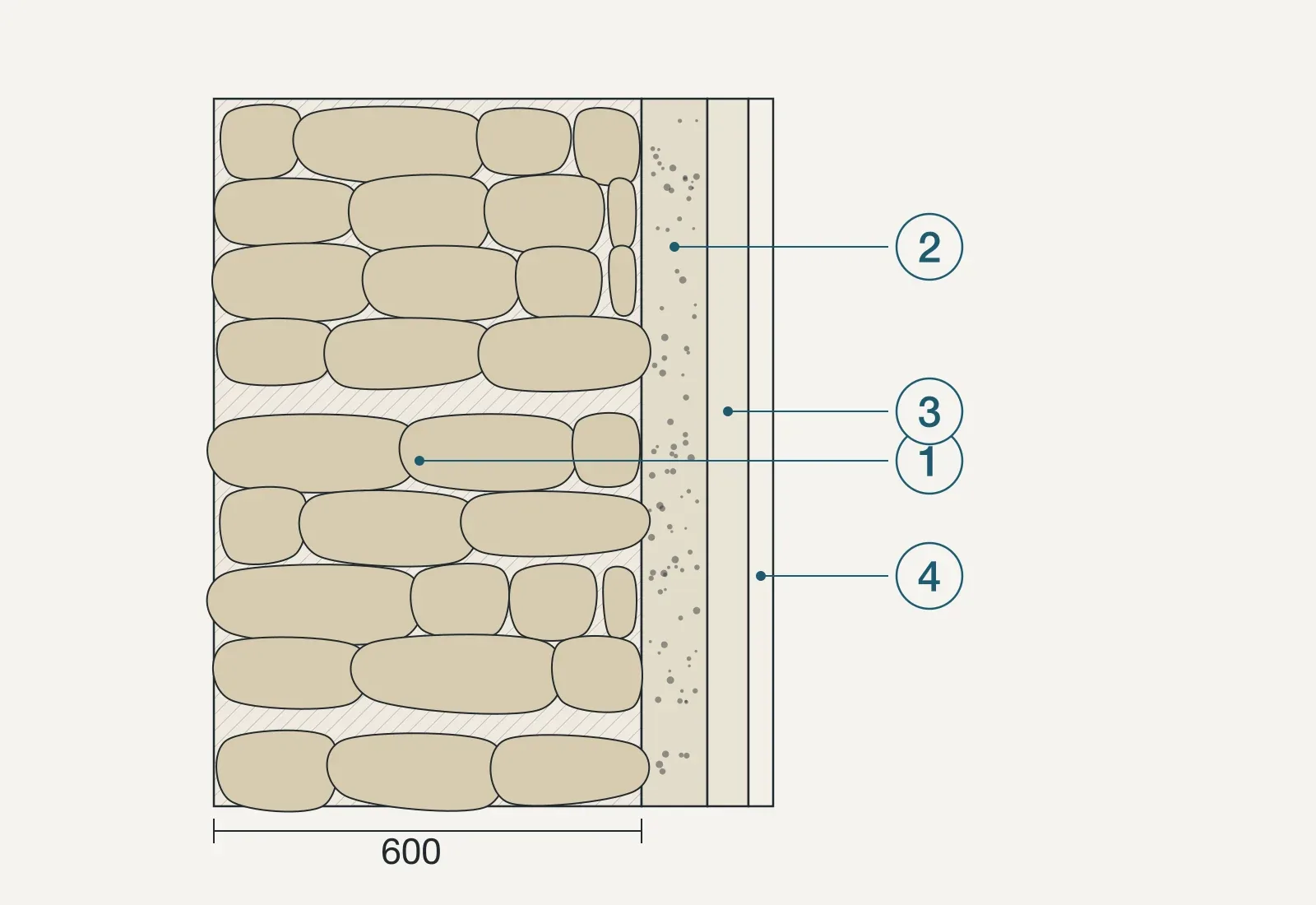
The drawing shows the four layers on a sixty centimetre stone wall:
- The stone, laid in lime mortar with small stones packed into the joints.
- A rough first coat, thrown on hard to fill the hollows.
- A second coat, levelled with a wooden float.
- A thin finishing coat of fine lime, polished with a steel trowel while it is still damp.
Each coat has to cure before the next. A render takes three weeks, not three days. We plan for that from the start.